

Why Vitamin C Remains The Gold Standard In Skincare
Free radicals, oxidative stress, unstable formulations and conflicting advice. Here is the clear-eyed science behind why L-Ascorbic Acid at the right concentration and pH remains the most important antioxidant in skincare.
There are hundreds of antioxidant ingredients in skincare. Niacinamide, Resveratrol, Coenzyme Q10, Astaxanthin, the list extends into the dozens and grows every year. And yet, after more than three decades of independent clinical research, L-Ascorbic Acid, Vitamin C in its active form, remains the benchmark against which every other antioxidant is measured.
This is not marketing. It is the outcome of peer-reviewed research, US patents and decades of use in clinical dermatology. Understanding why Vitamin C holds this position requires understanding the problem it solves.
The Problem: Free Radicals and Oxidative Stress
Every day, your skin is exposed to ultraviolet radiation, environmental pollutants, infrared radiation and ozone, all of which generate free radicals. Free radicals are unstable molecules that carry an unpaired electron. They stabilise themselves by stealing electrons from neighbouring molecules, triggering a chain reaction of oxidative damage that degrades collagen, disrupts DNA repair mechanisms and accelerates visible ageing.
This process is called oxidative stress. It is continuous, cumulative and invisible, at least until the damage becomes visible as fine lines, pigmentation and loss of elasticity. Sunscreen reduces UV-induced free radical formation. Antioxidants neutralise the free radicals that get through.
What Is L-Ascorbic Acid?
Vitamin C exists in multiple forms in skincare, Ascorbyl Glucoside, Magnesium Ascorbyl Phosphate, Tetrahexyldecyl Ascorbate, and others. These derivatives were developed largely to address the instability problems of L-Ascorbic Acid. Each must be converted to L-Ascorbic Acid by the skin to deliver antioxidant activity.
L-Ascorbic Acid is the form that is active without conversion. It is the most studied, most potent and most directly effective. It is also the most unstable and the most demanding in terms of formulation requirements, which is precisely why formulating it effectively is so difficult to do well.
Why Concentration and pH Are Everything
The skin's outermost layers are lipid-rich and slightly acidic. For L-Ascorbic Acid to penetrate this barrier and reach the living dermis where it can stimulate collagen synthesis and provide antioxidant protection, two parameters must be met precisely.
Concentration must be between 10% and 20%. Below 10%, insufficient L-Ascorbic Acid reaches the dermis to deliver meaningful activity. Above 20%, the increase in efficacy is marginal while the increase in irritation is significant.
pH must be between 2.5 and 3.5. L-Ascorbic Acid exists in its absorbable form only at this acidic pH. Formulations attempting to raise pH to reduce irritation simultaneously reduce penetration and efficacy.

The Ferulic Acid Effect
In 2005, SkinCeuticals published research establishing that combining L-Ascorbic Acid with Vitamin E (alpha-tocopherol) and Ferulic Acid produced a synergistic antioxidant effect that exceeded the sum of its parts. The combination not only stabilised the L-Ascorbic Acid (significantly extending shelf life) but amplified its photoprotective capacity eightfold versus Vitamin C alone.
Ferulic Acid is a hydroxycinnamic acid found naturally in the cell walls of plants. It is a powerful antioxidant in its own right and acts as a photostabiliser for both Vitamins C and E, absorbing UV radiation and preventing its degradation of the active antioxidants alongside it.
Why Vitamin C Belongs in Your Morning Routine
Antioxidant protection is most valuable during the hours when your skin faces its highest free radical burden, during daylight and UV exposure. This is why Vitamin C is a morning active. Applied in the morning, it sits within the skin providing neutralisation capacity throughout the day, working in tandem with your SPF.
Evening application is not without value, L-Ascorbic Acid supports collagen synthesis regardless of time of day, but it is not where the antioxidant role is most impactful. If you are using Vitamin C once daily, use it in the morning.
Vitamin C Myths Debunked
No ingredient in skincare attracts as many myths as Vitamin C. Here are the most persistent ones, set straight.
- Myth: A higher percentage is always better. Fact: Above 20%, clinical data shows diminishing returns and significantly increased irritation. 15% is the sweet spot validated by decades of research.
- Myth: Vitamin C derivatives are just as effective as L-Ascorbic Acid. Fact: Derivatives must convert to L-Ascorbic Acid in the skin. Conversion rates vary and are rarely published. L-Ascorbic Acid at the correct concentration and pH has the clearest clinical evidence.
- Myth: You should not use Vitamin C if your skin is sensitive. Fact: Many people with sensitive skin tolerate well-formulated Vitamin C without issue. Start with a 10% concentration and build. The irritation most people experience comes from poorly formulated products or incorrect use.
- Myth: Vitamin C and niacinamide cannot be used together. Fact: This concern is based on outdated chemistry. Modern formulations and normal skin temperatures prevent the interaction that was once cited as problematic.
- Myth: All Vitamin C serums are the same. Fact: Formulation varies enormously. pH, concentration, stabilisers, packaging and storage conditions all affect efficacy. Two products both labelled '20% Vitamin C' can have entirely different clinical performance.
The Clinical Evidence
A 2005 study published in the Journal of Investigative Dermatology found that a combination of 15% L-Ascorbic Acid, 1% Vitamin E and 0.5% Ferulic Acid provided fourfold protection against UV-induced erythema and an eightfold increase in photoprotection versus untreated skin.
A 2002 randomised double-blind study found that 5% L-Ascorbic Acid cream applied to photodamaged skin for six months produced statistically significant improvements in fine lines, wrinkling, tactile roughness and skin tone. At 15-20%, these effects are more pronounced.
Multiple independent studies confirm L-Ascorbic Acid's role in collagen synthesis, stimulating hydroxylase enzymes that are essential for procollagen stabilisation, independent of its antioxidant function. Vitamin C's skin benefits are therefore dual: protective and regenerative.
Frequently Asked Questions
What percentage of Vitamin C is effective in skincare?
Clinical research, including the foundational work of Dr Sheldon Pinnell at Duke University, establishes that L-Ascorbic Acid must be present at a concentration of 10-20% and formulated at a pH of 2.5-3.5 to penetrate the skin's lipid barrier and deliver measurable antioxidant protection.
Why does my Vitamin C serum turn orange or brown?
Oxidation. L-Ascorbic Acid is inherently unstable and degrades when exposed to light, heat and air. An oxidised serum has lost its active antioxidant capacity. Store your Vitamin C serum in a cool, dark place, and replace it if it darkens significantly.
Can I use Vitamin C with retinol?
Yes, but in separate routines. Vitamin C is a morning active (antioxidant protection during UV exposure); retinol is an evening active (cell renewal during sleep). Layering them in the same routine is unnecessary and may reduce the efficacy of both.
Is Vitamin C brightening or just protective?
Both. Vitamin C inhibits the enzyme tyrosinase, which drives melanin production, delivering measurable brightening and pigmentation reduction over consistent use. Simultaneously, its antioxidant activity neutralises the free radicals that cause UV damage, acting as a complementary layer to SPF.
What is Ferulic Acid and why is it in Vitamin C serums?
Ferulic Acid is a plant-based antioxidant that, when combined with Vitamins C and E, dramatically stabilises both actives and amplifies their antioxidant protection. The SkinCeuticals patent for C E Ferulic specifically establishes this combination as multiplying antioxidant protection eightfold versus Vitamin C alone.
Can dark-skinned tones use high-percentage Vitamin C?
Yes. Vitamin C is appropriate for all skin tones. Its ability to inhibit tyrosinase makes it particularly useful for addressing post-inflammatory hyperpigmentation common in deeper skin tones, while its antioxidant role is universal.
More from The Bay Blog
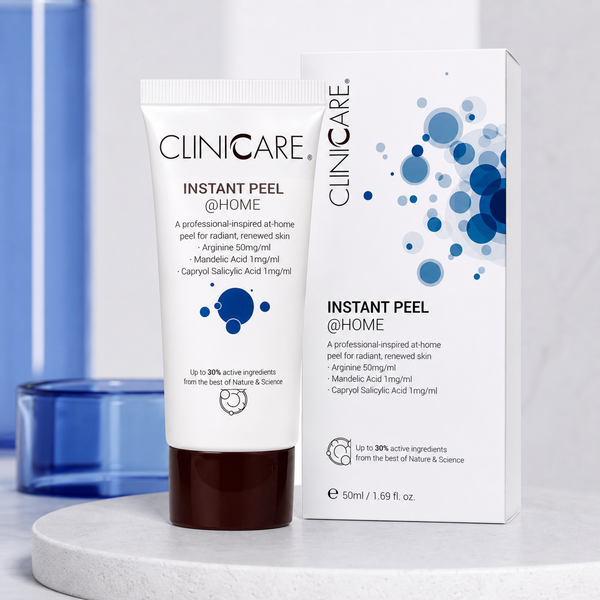 IngredientsWhat Is an At-Home Peel? ClinicCare Instant Peel @ Home, Explained
 Expert GuidesYour Best Anti-Ageing Product Isn't a Serum. It's SPF.
 Skin ConcernsPhyto Corrective with PDRN: How to Calm Redness and Sensitive Skin